

Know Your Data. Protect Its Value. Govern It with Confidence.
At MaxCorp Consulting, we help organizations understand, manage, protect, and govern their data throughout its lifecycle.
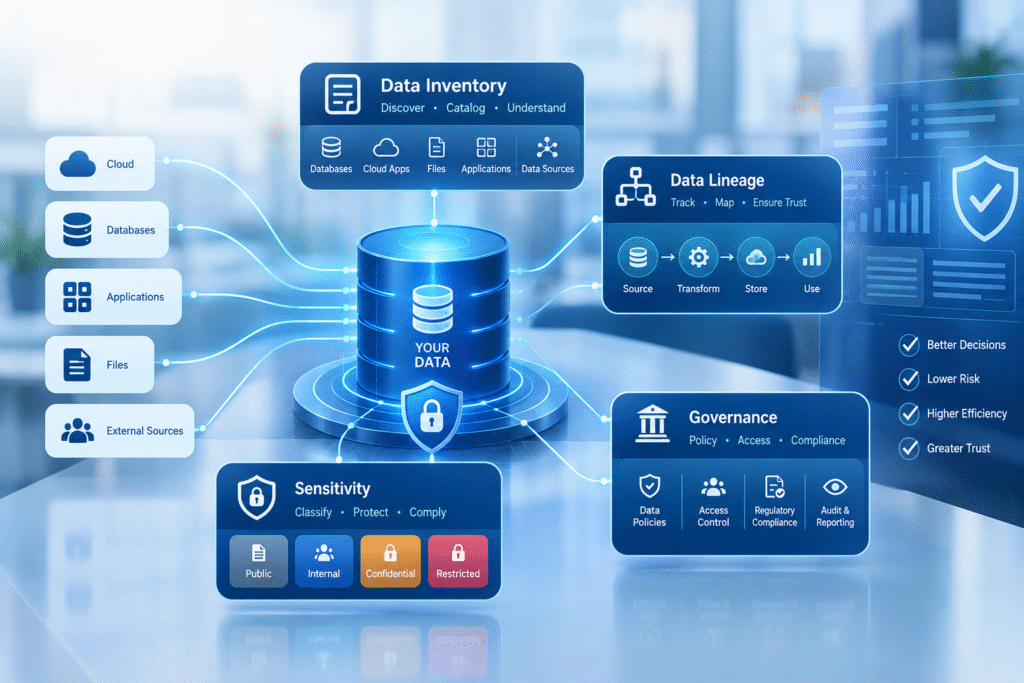
Our Data Governance & Information Management Services help businesses establish clear visibility into their data assets, understand how information flows across systems, apply appropriate data classification and sensitivity controls, and define effective data retention policies.
From data inventory and lineage to data mapping and information lifecycle management, we help organizations build a structured, reliable, and business-aligned approach to data governance.
Our goal is to help you improve data transparency, strengthen accountability, support privacy and compliance initiatives, and establish a trusted foundation for analytics, reporting, and informed decision-making.
MaxCorp Approach
We combine business analysis, data management expertise, and practical documentation methods to develop governance solutions that fit your organization’s size, complexity, and objectives.
Our approach typically includes:
- Discover: Identify data sources, information assets, stakeholders, and existing practices.
- Assess: Evaluate data classification, documentation, lineage, retention, ownership, and governance gaps.
- Document: Develop inventories, mappings, data dictionaries, policies, and supporting registers.
- Recommend: Prioritize improvements based on business needs, operational impact, and risk.
- Maintain: Establish review cycles, ownership, and processes to keep governance documentation current.
Engagements can be tailored to a specific department, business process, application, or broader organizational data environment.
Data Inventory & Discovery
Know what data you have, where it resides, and who is responsible for it.
We help organizations build a structured inventory of their data assets across business applications, databases, cloud platforms, shared drives, spreadsheets, and other information repositories.
Our services include:
- Data asset discovery and inventory development
- Documentation of data sources, formats, locations, and business purposes
- Identification of data owners, custodians, and key stakeholders
- Data source and application inventories
- Data dictionary development and metadata documentation
- Identification of data gaps, duplication, and governance improvement opportunities
Business value: Improve visibility into your data landscape, clarify accountability, and establish a foundation for effective data management.
2. Data Classification & Sensitivity Assessment
Understand the sensitivity of your data and apply appropriate handling practices.
Not all data carries the same level of business, operational, or privacy risk. We help organizations establish practical classification frameworks to identify information according to its sensitivity, business value, and handling requirements.
Our services include:
- Development of data classification frameworks and standards
- Classification categories such as Public, Internal, Confidential, and Restricted
- Identification and documentation of sensitive data elements
- Assessment of personal, confidential, financial, and business-critical information
- Definition of handling, access, sharing, and protection requirements
- Alignment of classification practices with organizational policies and applicable requirements
Business value: Improve awareness of sensitive information, support risk-based data protection, and promote consistent handling practices across the organization.
3. Data Lineage & Data Flow Mapping
Understand where your data comes from, how it moves, and how it is used.
We help organizations document the movement and transformation of data across systems, applications, databases, reporting platforms, and business processes.
Our services include:
- Source-to-target data lineage documentation
- Mapping of data movement between systems and applications
- Documentation of data transformations and processing activities
- Identification of upstream data sources and downstream dependencies
- Mapping of reporting and analytics data flows
- Documentation of key data handoffs between business teams and technology platforms
Business value: Improve traceability, support impact assessments, investigate data quality issues, and increase confidence in business reporting and analytics.
4. Data Mapping & Metadata Management
Create a consistent understanding of data across systems and business functions.
We help organizations document how data elements are defined, structured, related, and used across their information environment.
Our services include:
- Business and technical data mapping
- Source-to-target field mapping
- Data element definitions and business glossaries
- Metadata and data dictionary management
- Identification of inconsistent data definitions across systems
- Mapping of critical data elements to business processes and reports
- Documentation of data relationships and dependencies
Business value: Improve consistency across systems, reduce ambiguity, simplify data integration, and establish a common understanding of business information.
5. Data Retention & Information Lifecycle Management
Define how long data should be retained, how it should be managed, and when it should be reviewed or disposed of.
We help organizations develop structured data retention practices that reflect business needs, operational requirements, contractual obligations, and applicable legal and regulatory requirements.
Our services include:
- Data retention policy and standard development
- Data and records retention schedule documentation
- Identification of information categories and applicable retention requirements
- Documentation of retention periods, review dates, and responsible owners
- Data archival and disposition process design
- Secure disposal and deletion procedure documentation
- Alignment of retention practices with data classification and information lifecycle requirements
Business value: Improve consistency in information lifecycle management, reduce unnecessary data accumulation, support defensible disposition practices, and clarify retention responsibilities.
Retention periods and legal requirements should be validated with the organization’s qualified legal, privacy, or compliance advisors.
6. Data Governance Frameworks, Policies & Controls
Establish clear accountability and sustainable governance practices.
We help organizations define the roles, policies, standards, and processes needed to manage data consistently across business and technology teams.
Our services include:
- Data governance framework development
- Data ownership and stewardship models
- Data governance policies, standards, and procedures
- Data quality rules and accountability measures
- Governance roles, responsibilities, and decision-making processes
- Data governance maturity assessments and improvement roadmaps
- Governance documentation, reporting, and ongoing review practices
Business value: Establish consistent governance practices, clarify responsibilities, improve data quality management, and support continuous improvement.
Ready to Build an Intelligent Enterprise?!
MaxCorp Consulting provides the expertise to help you transform data into strategic business value – modernizing your data platform, implementing AI, improving decision-making, or strengthening your market intelligence capabilities
Let’s turn your data into a strategic advantage.
📞 Contact us today to discover how our Information Management & Data Consulting Services can transform your business.